Who are the interim council members in charge of Iran?
Following the seismic shift in regional geopolitics caused by the killing of Supreme Leader Ali Khamenei in joint Israeli-United States strikes, Tehran has moved swiftly to stabilize its domestic front.
Iranian authorities have officially activated a transition protocol, announcing the formation of a three-member leadership body to steer the nation through its most significant existential threat in decades.
As the world watches the unfolding power vacuum, the primary question for diplomats and intelligence agencies remains: Who are the interim council members in charge of Iran?
The Iranian government has already pledged to avenge the Saturday killing of Khamenei, who held absolute power for nearly 40 years. In the wake of his death, Tehran has launched retaliatory strikes against U.S. and Israeli assets across Gulf countries.
While U.S. President Donald Trump has publicly signaled a desire for “regime change,” the clerical establishment moved on Sunday to formalize the process of succession, placing the country’s immediate fate in the hands of three specific men.
Understanding the Constitutional Transition
Under Article 111 of the Constitution of the Islamic Republic, a temporary council is authorized to assume the Supreme Leader’s duties until the Assembly of Experts can elect a permanent successor.
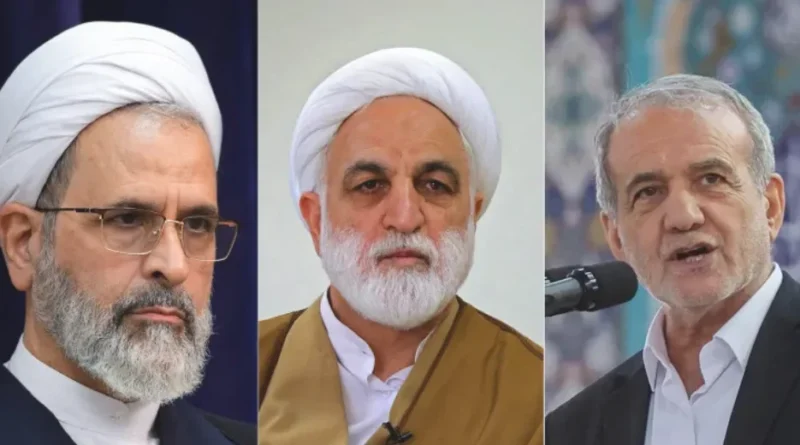
This specialized body is currently composed of President Masoud Pezeshkian, Chief Justice Gholam-Hossein Mohseni-Ejei, and Ayatollah Alireza Arafi, all of whom are members of the Guardian Council.
As the interim council members in charge of Iran, these three figures must balance the demands of a population reeling from war, an economy under siege, and the internal pressures of a hardline clerical elite.
Ayatollah Alireza Arafi: The Clerical Gatekeeper
Ayatollah Alireza Arafi represents the religious backbone of the transition. Having served on the Guardian Council since 2019, Arafi is a direct appointee of the late Supreme Leader.
His role is pivotal because the Guardian Council holds the power to vet all laws and candidates to ensure they align with Islamic principles.
Arafi is more than just a jurist; he is the deputy chairman of the Assembly of Experts—the very body tasked with choosing the next permanent Supreme Leader.
By leading Friday prayers in Qom and heading the national seminary system, Arafi ensures that the religious establishment remains unified while the interim council members in charge of Iran navigate the current military crisis.
Masoud Pezeshkian: The Reformist Face
President Masoud Pezeshkian, 71, provides a different optic for the council. A heart surgeon and veteran of the Iran-Iraq War, Pezeshkian was elected in 2024 on a platform of “constructive engagement” and economic stabilization.
As one of the interim council members in charge of Iran, his presence suggests a need to maintain some level of domestic civil order.
Despite his “moderate” label, Pezeshkian has remained staunchly loyal to the framework of the Islamic Republic. In the wake of Khamenei’s assassination, he shifted from his usual focus on social easing to a more militant stance, declaring it Iran’s “legitimate duty” to strike back at the masterminds of the “historic crime.”
Gholam-Hossein Mohseni-Ejei: The Hardline Enforcer
If Pezeshkian is the diplomat, Gholam-Hossein Mohseni-Ejei is the iron fist. Appointed Chief Justice in 2021, Mohseni-Ejei has a long history in the intelligence and prosecutorial sectors. He is widely viewed as a hardline conservative who views domestic dissent as a Western-backed conspiracy.
His role among the interim council members in charge of Iran is primarily focused on internal security. Following President Trump’s recent calls for the Iranian public to topple the government, Mohseni-Ejei’s influence will be critical in suppressing potential uprisings. He has previously warned that there will be “no leniency” for those labeled as “rioters” or agents of foreign influence.
Quick Facts: Iran’s Transitional Leadership
| Member | Primary Role | Political Leanings | Notable Background |
| Masoud Pezeshkian | President | Reformist | Former Intelligence Minister, known for his “no leniency” stance toward domestic protesters and civil unrest. |
| G.H. Mohseni-Ejei | Chief Justice | Hardline Conservative | Former Intelligence Minister; known for his “no leniency” stance toward domestic protesters and civil unrest. |
| Ayatollah Alireza Arafi | Clerical Representative | Hardline Loyalist | A heart surgeon and military veteran, he represents the “moderate” wing and is the public face of the government. |
News source
“Source: This report is based on internal government announcements and reporting from Al Jazeera regarding the activation of Article 111.”