Ramadan in Gaza: Breaking Fast on the Edge of War
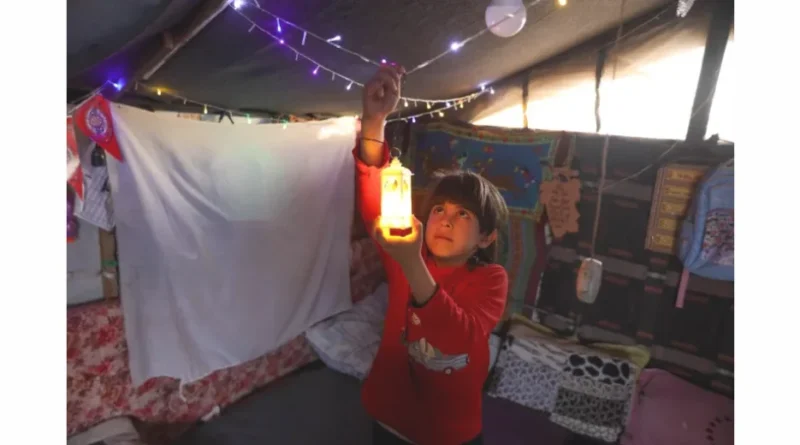
Ramadan in Gaza has arrived under canvas roofs instead of concrete homes, as thousands of displaced families mark the holy month inside crowded camps. In the Bureij refugee area in central Gaza, Maisoon al-Barbarawi prepares a small but heartfelt welcome for Ramadan inside her tent.
Simple decorations hang from the worn ceiling, while colorful drawings line the fabric walls—handmade by camp residents to bring a sense of joy to the start of the holy month.
“We brought you decorations and a small lantern,” Maisoon tells her nine-year-old son Hasan, smiling despite visible exhaustion. Her limited resources did not stop her from buying the small lantern.
“My means are limited, but what matters is that the children feel happy,” she says. For her, the decorations are a way to push back against the grief and hardship that have defined the past two years of war.
Known in the camp as Umm Mohammed, the 52-year-old mother of two says her children are her greatest blessing. “Every day they are safe is a day worth gratitude and joy,” she says, balancing pride with fear.
For many families, Ramadan in Gaza this year feels different because of the fragile ceasefire that has reduced the intensity of fighting. The relative calm contrasts with the previous two years, when bombardments and displacement defined daily life.
“The situation is not completely calm,” Maisoon explains. “Everyone knows the war hasn’t truly stopped. But compared to before, things are less intense.”
She spends her days helping camp administrators bake bread and prepare dates and water for distribution just before the call to prayer.
“This is the third Ramadan we’ve spent in displacement,” she says. “We lost our homes, our families, and many loved ones. But here, we try to support each other.”
Her own home in southeastern Gaza was destroyed at the beginning of the war, forcing her family to move between camps before settling in Bureij under what she describes as “very bad conditions.”
“We are trying to create life and joy out of nothing,” she says quietly. “Ramadan and Eid come and go, but our situation remains the same.”
Fear beneath the blessings
Despite everything, Maisoon still calls Ramadan a blessing. On the first day of fasting, she had not yet decided what to cook because her limited income would only allow a simple meal.
Her main prayer is for peace.
“I will pray that the war never returns,” she says, pointing to bullet holes in her tent left by drone fire days earlier.
That fear is shared across the territory. Many remember last year’s Ramadan, when fighting resumed in mid-March and border crossings closed, cutting off food aid and pushing Gaza toward famine.
“People keep telling us to store flour and food because the war might come back,” she says anxiously. “Last Ramadan was famine and war at the same time. My little son even prayed for death because he was so hungry.”
Aid parcels and painful absences
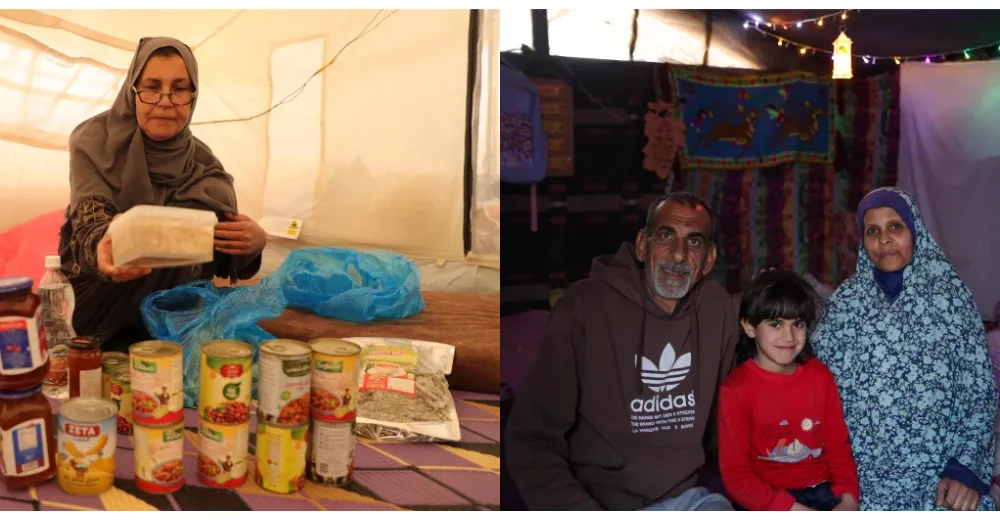
Across Gaza, many families still rely on humanitarian aid to survive Ramadan in Gaza. Hanan al-Attar, a 55-year-old mother of eight, received a food parcel on the first day of the holy month.
Opening it with a smile, she lists its contents: fava beans, halva, dates, lentils, oil, cheese, and more.
“This will be perfect for tomorrow’s suhoor,” she says.
Hanan fled from Beit Lahiya in northern Gaza to Deir el-Balah a year ago. She now shares a tent with 15 relatives, including children and grandchildren.
“Today, thank God, we received assistance,” she says. “This eases my worry about what we will break our fast with.”
She admits she secretly saved a little money to prepare a special iftar of potatoes, rice, and minced meat.
“Fasting requires protein,” she says softly, noting that food must be purchased day by day because there is no electricity or refrigeration.
But the hardest part of Ramadan is the absence of her two sons, both killed in a strike last year.
“This is the first Ramadan after the martyrdom of my sons,” she says through tears. “When the family gathers, and members are missing, you feel deep pain.”
Cooking with fire and wind
In the camp, daily life remains harsh. Hanan cooks over an open fire because of ongoing gas shortages.
“The wind blows out the flame, and my son shields it with plastic,” she says.
She had managed to refill an eight-kilogram gas cylinder two months earlier but saved it for Ramadan.
“Gas is like treasure for us,” she explains. “I planned to use it for suhoor. It’s difficult to light a fire at dawn.”
Memories of last year’s famine still haunt her. She recalls grinding lentils to replace flour and cutting bread into smaller portions to make it last.
“I make it smaller so it’s enough for everyone,” she says.
Despite the hardships, her final wish echoes across Gaza this holy month.
“May this Ramadan be one of goodness and peace,” she says. “And may we return to our homes.”