Iran Confirms Death of Ali Khamenei After U.S.–Israeli Air Strikes
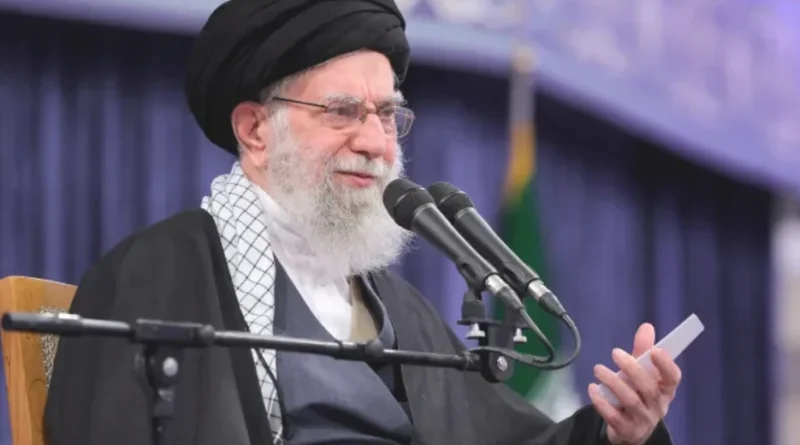
Iranian state media have officially confirmed that Supreme Leader Ayatollah Ali Khamenei was killed inside his office during coordinated U.S.–Israeli military strikes, ending hours of conflicting reports about his fate. The announcement follows earlier claims by officials in Washington and Tel Aviv that the longtime Iranian leader had been eliminated in the opening wave of attacks.
Authorities declared a 40-day national mourning period for the 86-year-old cleric, signaling the profound political and religious implications of his death. State television interrupted regular programming to broadcast Quranic recitations and tributes, describing Khamenei as a “martyr of resistance.”
The confirmation came after initial dispatches from Tasnim and Mehr news agencies had insisted that Khamenei remained “steadfast and firm in commanding the field.” However, subsequent official statements reversed that position, acknowledging he had been killed during precision strikes targeting senior leadership facilities in Tehran.
U.S. President Donald Trump claimed responsibility for the operation in a post on his Truth Social platform, stating that advanced intelligence and surveillance systems had tracked Khamenei’s movements. Trump described the strike as decisive and urged what he called a historic opportunity for the Iranian population to reclaim political control.
He further suggested that elements of the Islamic Revolutionary Guard Corps (IRGC) and domestic security forces should align with “Iranian patriots.”
Israeli Prime Minister Benjamin Netanyahu had earlier referenced “growing signs” that Khamenei had been killed, framing the strikes as part of a broader effort to dismantle Iran’s military and nuclear leadership structure. Reports carried by Reuters, citing a senior Israeli official, indicated that Khamenei’s body had been located following the attack.
Khamenei had served as Iran’s supreme leader since 1989, succeeding Ruhollah Khomeini, the architect of the 1979 Islamic Revolution. As supreme leader, he wielded ultimate authority over Iran’s executive, legislative, and judicial branches, as well as the armed forces and the powerful IRGC.
His position combined political command with religious legitimacy, making him the central pillar of the Islamic Republic’s governance structure.
Escalating Conflict and Civilian Impact
Saturday’s strikes reportedly targeted 24 provinces across Iran, with Iranian media citing the Red Crescent as confirming at least 201 fatalities. Among the most controversial incidents were air strikes on two schools, including the Shajareh Tayyebeh girls’ elementary school in the southern city of Minab, which reportedly caused significant civilian casualties. Additional attacks were reported east of Tehran.
Netanyahu stated that multiple “senior figures” in the Revolutionary Guard and Iran’s nuclear programme were eliminated during the coordinated assault, pledging that Israeli operations would continue. Trump echoed that message, indicating that “heavy and pinpoint bombing” would proceed uninterrupted for as long as deemed necessary.
Tehran responded with what it characterized as calibrated counterstrikes targeting U.S. and Israeli-linked sites. Across the Gulf, air-defense networks were placed on high alert in nations that host American military installations — including Kuwait, Qatar, the United Arab Emirates, and Bahrain.
The Islamic Revolutionary Guard Corps (IRGC) said multiple waves of operations were in progress, portraying the campaign as a measured and proportional act of retaliation rather than an escalation.
Leadership Transition and International Reaction
Analysts suggest that contingency plans for such a scenario have long been in place within Iran’s political system. Barbara Slavin of the Stimson Center noted that a provisional leadership council could assume control, and such a mechanism may already have been operating discreetly due to Khamenei’s advanced age and regional instability.
At the United Nations, Secretary-General António Guterres convened an emergency Security Council session, warning that the escalation risks triggering uncontrollable consequences in an already volatile region. He called for immediate de-escalation and a cessation of hostilities.
Iran’s ambassador to the UN condemned the strikes as premeditated aggression and characterized them as violations of international law. The U.S. representative defended the operation as lawful and necessary to prevent Iran from developing nuclear weapons, emphasizing global security concerns.
Meanwhile, China and Russia expressed alarm over the rapid deterioration of regional stability and demanded an immediate halt to military actions.
Khamenei’s assassination marks a watershed moment in Middle Eastern geopolitics. Beyond the immediate military exchanges, the development injects deep uncertainty into Iran’s internal political landscape and raises the risk of a broader regional confrontation.
With leadership succession, domestic stability, and international diplomacy all in flux, the coming days are expected to be critical in determining whether the crisis expands or stabilizes.