
How Epstein and Maxwell Exploited a Prestigious Midwest Arts School to Target Young Girls
Long before their criminal convictions, Epstein and Maxwell allegedly used philanthropy and personal influence to build relationships at a prestigious Michigan arts boarding school, where former students now say they were targeted as teenagers.
Department of Justice records, court testimony, and interviews with past administrators outline how the pair cultivated access to Interlochen Center for the Arts, an elite institution located between two lakes near Traverse City. Known nationally for its rigorous programs in music, theater, dance, and visual arts, the academy has produced prominent alumni, including Josh Groban, Norah Jones, and Felicity Huffman.
Former students allege that Epstein and Maxwell leveraged their financial contributions and social standing to form relationships with underage girls attending both summer camps and the year-round boarding school during the 1990s.
How Epstein and Maxwell Built Influence on Campus

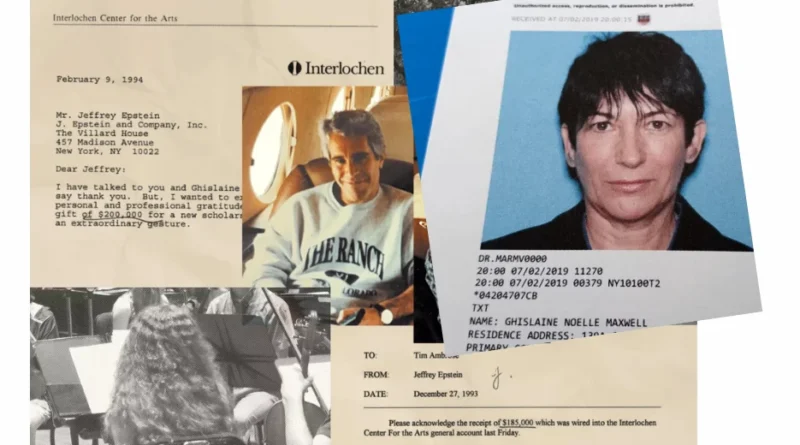
Jeffrey Epstein’s connection to the school reportedly began decades earlier when he attended a summer music program as a teenager. In the 1990s, he renewed contact as a donor, eventually contributing hundreds of thousands of dollars for campus projects, scholarships, and a guest lodge.
Administrators at the time viewed the benefactor relationship as a positive development. Through their donations and alumni status, Epstein and Maxwell gained recognition within donor circles and were welcomed at events, concerts, and summer sessions.
Former officials described the campus culture during that era as unusually open. Students, faculty members, donors, and visiting performers often mingled freely in shared spaces. While policies discouraged unsupervised interaction between adults and minors, some former administrators later acknowledged that enforcement was inconsistent in such an open environment.
According to testimony and interviews, Epstein and Maxwell used that accessibility to approach teenage students, sometimes striking up casual conversations that later evolved into private contact.
Allegations From Former Students
One woman who later testified at Maxwell’s 2021 criminal trial said she first encountered Epstein and Maxwell at the school’s summer arts camp when she was 13 years old. She described initially friendly interactions that gradually developed into what she now identifies as grooming behavior.
Another former student recounted a similar pattern. She said the couple presented themselves as mentors interested in supporting young artistic talent. Promises of tuition payments and introductions to influential figures were allegedly used to build trust.
In interviews and court records, both women described how Epstein and Maxwell would engage students in conversations about their ambitions, families, and financial needs. In some instances, financial assistance was offered or provided, deepening the sense of obligation and dependence.
One former student said Epstein paid her tuition for the boarding school and discussed funding her higher education at a prestigious conservatory. Over time, she said she felt emotionally manipulated, describing the relationship as controlling and transactional.
When she began declining certain requests, she alleged that financial support was withdrawn. The shift, she said, revealed what she now believes was a calculated strategy by Epstein and Maxwell to maintain influence.
Donations, Access, and Institutional Trust
Between the early 1990s and early 2000s, Epstein donated more than $400,000 to the institution. His contributions reportedly funded the construction of an on-campus lodge, created a scholarship fund, and supported cultural events.
Former administrators said that through these financial commitments, Epstein and Maxwell developed working relationships with senior development officials responsible for donor engagement. At the time, there were no formal complaints on record involving inappropriate behavior on campus.
Donor recognition programs also encouraged engagement between benefactors and scholarship recipients. Although administrators say they do not recall arranging private meetings, the culture of donor appreciation may have created opportunities for informal interaction.
Critics now argue that the combination of prestige, trust, and philanthropy provided a framework that Epstein and Maxwell could exploit without immediate suspicion.
Broader Criminal Cases
Epstein was arrested in 2019 on federal sex trafficking charges and died in custody while awaiting trial. Maxwell was convicted in 2021 on sex trafficking-related offenses and sentenced to 20 years in prison.
The allegations connected to the arts academy form only a small part of the broader criminal investigations involving Epstein and Maxwell, which spanned multiple states and high-profile individuals.
For former students who spoke publicly, however, the experience remains deeply personal. One woman said the qualities that make young artists successful — openness, trust, and ambition — were the same traits that were manipulated.
Institutional Reforms and Ongoing Scrutiny
School officials say that since the public exposure of Epstein’s crimes, policies and security measures have been significantly strengthened. Today, unsupervised contact between students and outside adults is prohibited. The campus now features controlled access points, 24-hour security patrols, and surveillance systems.
Internal reviews conducted in 2008 and again in 2019 reportedly found no documented complaints involving Epstein during the period of his donations. Administrators have stated that record-retention policies from the 1990s may limit what documentation still exists.
Despite those findings, the association with Epstein and Maxwell has cast a lasting shadow over the institution’s reputation. Leadership has described the situation as deeply troubling and inconsistent with the school’s mission of nurturing young talent in a safe environment.
Former students say their purpose in speaking out is not to condemn the institution but to shed light on how influence and wealth can override safeguards. They argue that understanding how Epstein and Maxwell operated within trusted environments is essential to preventing similar abuses in the future.
As investigations and public discussion continue, the case underscores the vulnerabilities that can arise when prestige, philanthropy, and power intersect — and how easily trust can be exploited when warning signs go unnoticed.