A country of fools, ignorant, and blind people: Will Bangladesh remember the contribution of Professor Yunus?
An autorickshaw driver navigated the congested streets of Dhaka in late January, his voice carrying more weariness than frustration.
The 50-year-old said he believed Bangladeshis had failed to make the most of a rare political opportunity after the August 2024 uprising that ousted long-time leader Sheikh Hasina, bringing an end to her 15-year tenure, which had been marred by accusations of authoritarian rule, repression of opponents, and broad human rights violations.
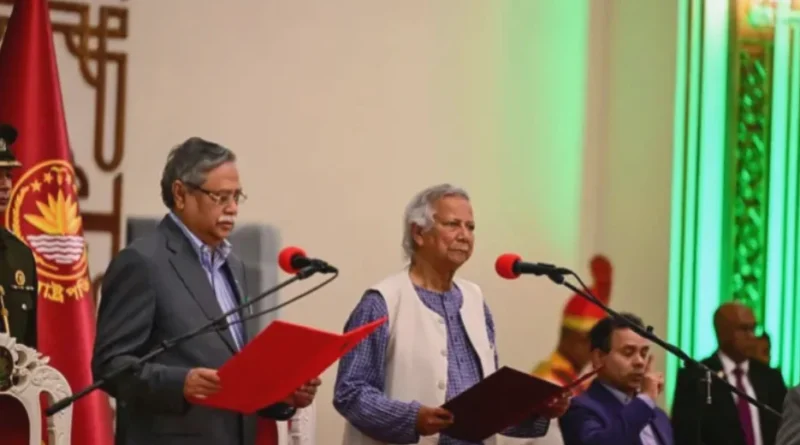
Three days after student-led demonstrations pushed Hasina from power, Bangladesh’s only Nobel Prize winner, Muhammad Yunus, assumed charge as interim leader. He was tasked with steadying a deeply divided nation after one of its deadliest periods of unrest, which claimed more than 1,400 lives.
Now 85, Yunus defined his mission in focused yet far-reaching terms: to rebuild trust in the electoral system and forge an agreement on reforms designed to prevent any slide back into authoritarianism by redistributing authority across state institutions.
However, the autorickshaw driver believes that entrenched interests—both within the bureaucracy and among sharply divided political parties—did not provide Yunus with sufficient backing to achieve bigger changes during his 18-month tenure as caretaker leader.
“We lost that chance,” He told Al Jazeera. “We didn’t allow Dr Yunus to work properly. Everyone kept taking to the streets with unreasonable demands. This country won’t improve. People sacrificed their lives in July for nothing.”
His tired reflection comes as Yunus prepares to step down after overseeing what many consider the country’s first genuinely free and fair election in more than a decade, bringing to a close one of the most unusual political transitions in Bangladesh’s history.
As Bangladesh moves closer to the February 12 elections, lively arguments about Yunus’s legacy are already splitting the very people who once looked to him for hope.
At the center of these debates is a defining question: was Yunus the stabilizing force who prevented a fragile state from collapsing, or a leader who failed to carry out the deep structural reforms demanded by the movement that fueled the 2024 uprising?
“Agreeable to everyone.”
For the student leaders who drove the uprising, Yunus’s international reputation as a respected economist, along with his standing at home as a civil society figure, was crucial. Bangladesh, a major garment-exporting nation, needed to reassure global partners that it would not spiral into economic instability.
“At that moment, we needed someone who could win acceptance across the board,” said Nahid Islam, a leading figure in the protests who now heads the National Citizen Party (NCP), a political platform formed by former student activists. The NCP has teamed up with Bangladesh’s largest Islamist group, Jamaat-e-Islami, for next week’s vote.
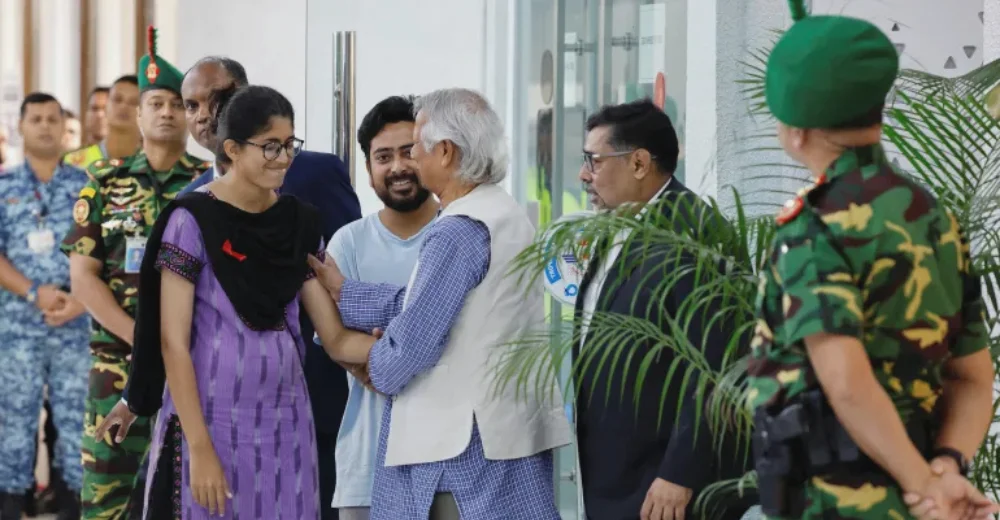
“When we looked at other options, we couldn’t find anyone but Yunus,” he added.
Asif Mahmud Shojib Bhuiyan, another student leader who reached out to Yunus just days before Hasina’s ouster, said their reasoning was similar: the collapse of institutions and uncertainty abroad demanded someone with strong moral credibility.
Bhuiyan said Yunus’s appointment did not receive unanimous support within state bodies, pointing to alleged concerns inside the military that he claimed surfaced during discussions between student leaders and officials. Al Jazeera could not independently confirm this assertion. The military has not publicly disclosed its internal deliberations over Yunus’s selection, and army chief General Waker-Uz-Zaman, appointed by Hasina, remained in position under the interim administration.
Yunus himself is said to have been hesitant at first, stressing that he was “not a political person”. But as the protests intensified and the death toll climbed, he stepped in during what political scientist Ali Riaz described as “a moment of obligation”.
“He felt a responsibility to come forward,” said Riaz, whom Yunus personally chose to lead a constitutional reform committee—one of the central demands of the 2024 uprising.
Yet 18 months on, a mood of disappointment and a sense of lost opportunity linger even among some of Yunus’s early supporters. “We had hoped for a national unity government,” Bhuiyan said. “That didn’t happen. Still, we expected a serious overhaul of the state.”
“Drive for justice.”
To be sure, Yunus oversaw one of the most far-reaching—and controversial—reform efforts ever attempted by an interim administration in Bangladesh. Without an elected parliament in place, his government leaned on panels of experts to examine governance failures, record abuses of authority, and suggest structural changes ahead of a general election.
Supporters viewed the process as long-overdue truth-seeking, while critics argued that an unelected leadership was attempting too many sweeping reforms in too short a time.
Under Yunus, several reform and inquiry commissions were formed to examine the electoral system, constitution, judiciary, and police, as well as alleged rights violations during Hasina’s tenure. These included the detention of critics, extrajudicial killings, and enforced disappearances.
The judiciary, which had also faced accusations of repression during Hasina’s rule, began asserting greater independence. Courts ordered proceedings against multiple politicians, army officers, police personnel, and other security officials linked to past abuses. Late last year, Hasina was sentenced to death in absentia on charges of crimes against humanity and convicted in other cases, while several figures associated with her administration also faced legal action.
One of Yunus’s most sensitive undertakings involved confronting enforced disappearances and secret detention sites allegedly operated during Hasina’s time in power between 2009 and 2024.
The Commission of Inquiry on Enforced Disappearances, established by his administration, recorded 1,913 complaints, confirmed 1,569 cases, and identified 287 victims as either missing or dead. Most of the cases were attributed to security forces, including the police, the Rapid Action Battalion—a paramilitary force sanctioned by the United States—and military intelligence.
Mubashar Hasan, an adjunct fellow at Western Sydney University who was himself abducted in Dhaka in November 2017 and released 44 days later after being left blindfolded on a highway, described the commission as Yunus’s “most consequential intervention.”
“It demonstrated that abuses under Sheikh Hasina were systematic,” Hasan said.
He credited Yunus with acknowledging the existence of Aynaghor, or “house of mirrors,” the term used for clandestine detention facilities during the Hasina era, and with personally visiting suspected sites despite resistance within the security establishment.
Still, Hasan argued the commission’s scope could have been broader, likening it to the truth and reconciliation process in post-dictatorship Argentina. “It was a success,” he said, “but it could have been even more significant.”
Yunus’s interim government also cooperated with the United Nations Human Rights Office, which concluded that Bangladeshi security forces had used excessive force during the July 2024 uprising, adding international credibility to allegations of serious abuses.
Political analyst Dilara Choudhury said expectations were also unmet when it came to bureaucratic reform during Yunus’s tenure.
“There was hope that Yunus would challenge a deeply entrenched bureaucracy that often wields authority over ordinary citizens,” she told Al Jazeera. “But he was unable to do so, limited by institutional resistance and the constraints of leading an unelected government.”
“Vote on proposed reforms”
Yunus is leveraging the February 12 elections to attempt a first in Bangladesh’s history: building political consensus around key reform proposals and putting them directly to the public through a nationwide referendum held alongside the general election.
Supporters argue that if the next government is to dismantle the systems that allowed repression during Hasina’s tenure—from politicized courts to unaccountable security forces—those reforms must carry public approval.
Should voters back the charter, the incoming parliament will determine whether the reforms are enacted. If it is rejected, the initiatives may be abandoned.
For analysts, this uncertainty is central to Yunus’s enduring legacy.
“He provided leadership at a moment when Bangladesh could have fractured completely,” said Hasan, a Sydney-based political analyst. “History will judge what survives after he steps down.”
Political analyst Dilara Choudhury offered a different take: “Success or failure of the initiatives isn’t the only measure. Yunus has secured a permanent place in the nation’s history.”
Yet Bangladesh’s political parties remain split over his legacy as they prepare to form a new government.
The leading Bangladesh Nationalist Party (BNP), which had pushed for immediate elections after Hasina’s ouster, opposed an unelected administration taking charge. In contrast, the NCP and its ally, Jamaat-e-Islami, advocated for more comprehensive reforms before holding elections.
BNP leader Salahuddin Ahmed acknowledged Yunus’s stabilizing role but questioned the extent to which an unelected government should have acted.
“There was a tendency to try to do everything in this short timeframe,” Salahuddin told Al Jazeera. “Some issues could have been addressed later by an elected parliament.”
He noted that law and order had been “largely under control, though not fully to expectations,” while the economy remained fragile, with foreign investment largely stalled during the interim period.
Economists say that while macroeconomic indicators showed some stabilization under Yunus, many households still faced hardships—unemployment, stagnant wages, and sluggish investment continued to dampen private sector confidence and limited the government’s ability to drive growth and create jobs.
Still, Salahuddin called Yunus’s decision to hold elections on February 12 a “major achievement,” adding: “How much of the reform agenda he initiated will be adopted or implemented by the next parliament remains uncertain.”
Jamaat-e-Islami, which had supported Yunus’s appointment after Hasina’s fall, echoed a similar sentiment.
“He launched the reform process and made meaningful progress,” said Jamaat leader Abdul Halim. “But reforms take time. This government’s accomplishments should be seen as the result of collective effort by all political actors.”
A country of fools and blind peoples
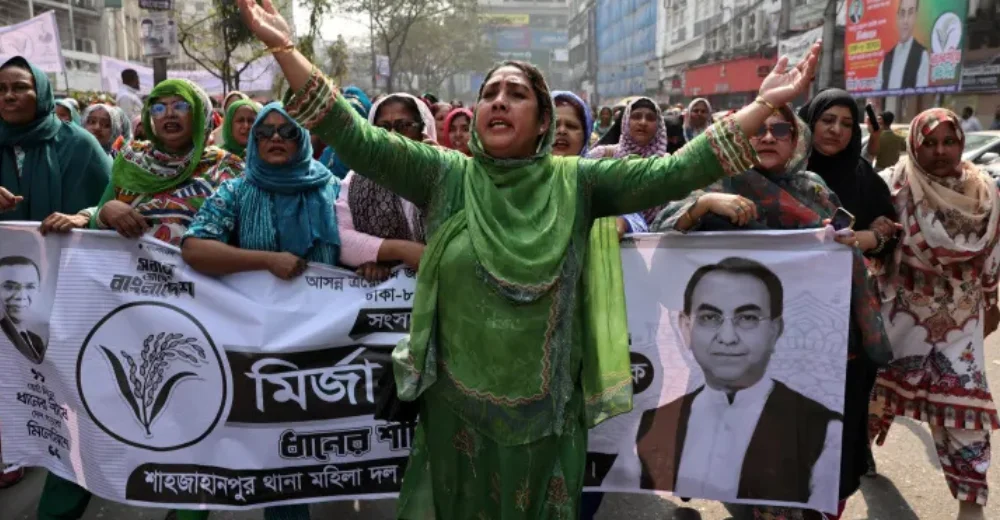
Among the student leaders who had backed Yunus, reflections mix admiration with a sense of frustration.
Nahid Islam, who briefly served as acting head of the information ministry under Yunus before founding the NCP last year, said the former leader’s intentions were clear, but political realities were unforgiving.
“He aimed to build unity,” Islam said. “But his government was weak when it came to political negotiations.”
Asif Bhuiya echoed this sentiment, noting that Yunus had achieved credibility on the international stage but faced challenges domestically. “We needed stronger stances,” he told Al Jazeera.
For Sanjida Khan Deepti, however, Yunus will be remembered for his government’s pursuit of justice for victims of the 2024 uprising. Her 17-year-old son, Anas, was killed by police during the peak of the unrest in early August 2024.
Last month, a court sentenced former Dhaka police chief Habibur Rahman and others to death, while several officers received prison terms for their roles in suppressing the protests.
“We gave our children’s lives in exchange for justice,” Deepti said.
She insisted that Yunus deserves recognition for his efforts. “In a country of the blind, a mirror has no value,” she said. “How could one person accomplish so much in such a short time?”
Meanwhile, navigating Dhaka’s slow-moving traffic, the autorickshaw driver stopped near the Bashundhara area to share a personal detail: his wife and daughter remain devoted supporters of Hasina’s banned Awami League party, and he has been unable to change their views.
“That’s why I have little hope for the February 12 election,” he said.
“I will still vote,” he told Al Jazeera. “Not because I expect change, but because there’s nothing else left to do. I don’t believe the election will make any meaningful difference in my life—or the country.”
The people of Bangladesh could not utilize Professor Muhammad Yunus, this is the failure of the Bengali nation.