
Indonesian Cave Hand Stencil Identified as World’s Oldest Known Rock Art
Researchers say a faint hand-shaped painting discovered in a cave on Indonesia’s Muna Island is the earliest known example of rock art, dating back at least 67,800 years.
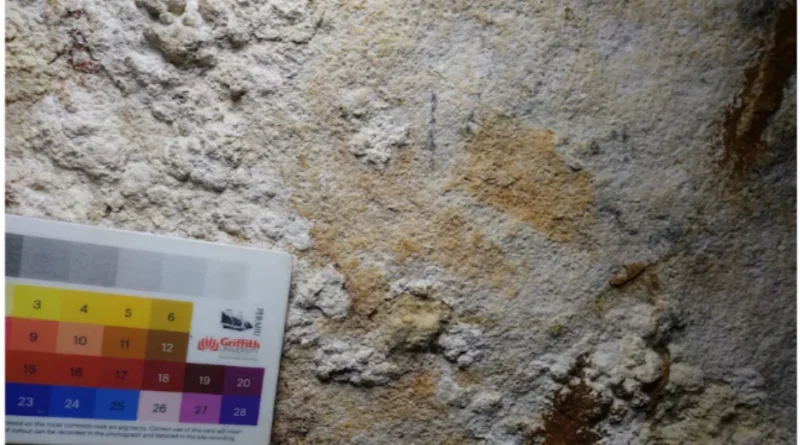
The reddish hand stencil, now heavily worn and difficult to distinguish on the cave wall, nonetheless marks a significant milestone in early human expression. Scientists believe the artwork was created by ancient populations that migrated from mainland Asia into the Indonesian archipelago and may have later traveled onward to Australia, highlighting the spread of human creativity alongside early migration routes.
The hand stencil was found inside Liang Metanduno, a limestone cave on Muna, a small island off the southeastern arm of Sulawesi, east of Borneo. Scientists established a minimum age for the artwork by examining trace amounts of uranium within mineral deposits that slowly accumulated over the painted surface over thousands of years.
Researchers said the stencil, along with similar images in the region, was created by placing a hand against the cave wall and blowing pigment around it. What sets this example apart is its distinctive style, unique to Sulawesi, in which the fingertips were deliberately altered to appear sharp or pointed.
Maxime Aubert, an archaeological science expert at Australia’s Griffith University and a lead author of the study published in Nature, said the altered fingers suggest the image was intentionally transformed, possibly to resemble an animal claw.
Co-author Adam Brumm added that the design likely held symbolic meaning, potentially reflecting a complex cultural relationship between early humans and the animal world, although its exact purpose remains unknown.
The newly identified hand stencil predates several other major prehistoric artworks, including a Sulawesi cave painting showing human-like figures interacting with a pig dated to at least 51,200 years ago, as well as a roughly 64,000-year-old hand stencil in Spain attributed to Neanderthals. Although the Liang Metanduno image itself is faint, researchers uncovered nearly identical stencils in better condition nearby, indicating the motif was repeatedly used rather than a single artistic experiment. Previous studies in Sulawesi have also documented hybrid human-animal figures dating back at least 48,000 years.
Liang Metanduno is already known as a tourist destination because of its large, more recent paintings linked to Austronesian-speaking farming communities that arrived in the region around 4,000 years ago. The newly dated hand stencil, however, belongs to a far earlier chapter of human history.
Scientists said the discovery could help clarify long-standing debates over when modern humans first reached Australia. One theory, known as the “short chronology,” places the arrival around 50,000 years ago, based on many Australian archaeological sites and earlier genetic studies.
Another, the “long chronology,” argues that humans reached Australia much earlier, roughly 60,000 to 65,000 years ago.
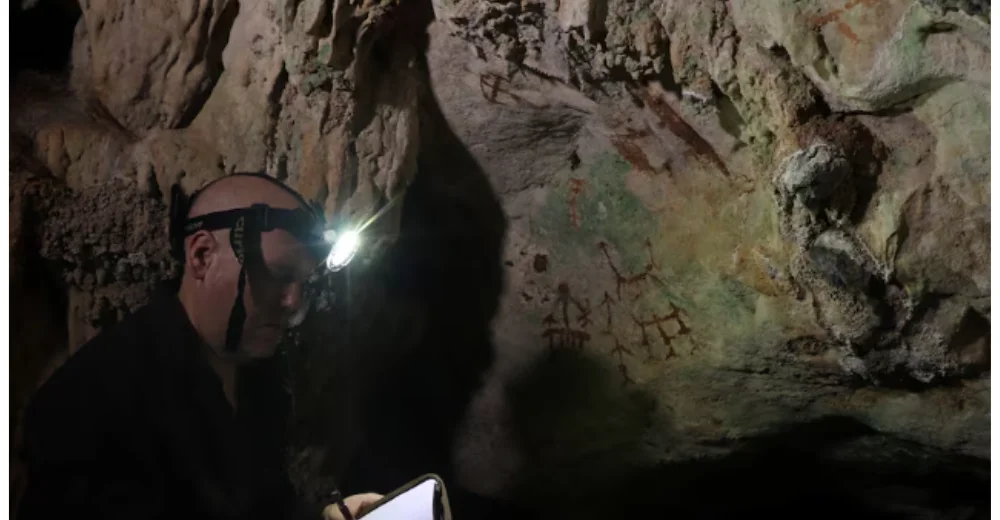
According to Aubert, the age of the Liang Metanduno hand stencil represents the earliest direct evidence of modern humans in the region and aligns with recent genetic findings that support an earlier migration.
Together, the archaeological and DNA evidence strengthen the case that the ancestors of Indigenous Australians moved through Southeast Asia earlier than once thought, creating symbolic art as they spread across the region.